
In this age of fast-paced industrialization and revolutionary technological change, the emerging role of heavy equipment spare parts suppliers in UAE and international markets also continues to experience a paradigm shift. As the markets expand and other sectors such as construction, mining, agriculture, and logistics increase the use of heavy equipment, the demand for quality heavy equipment spare parts also continues to grow from strength to strength in this manner. Under this scenario, SINTRA continues to be the number one heavy equipment solutions provider, with a gamut of after-sales services, heavy equipment spares, reconditioned engines, and consulting to its credit for its Middle Eastern and international clientele.
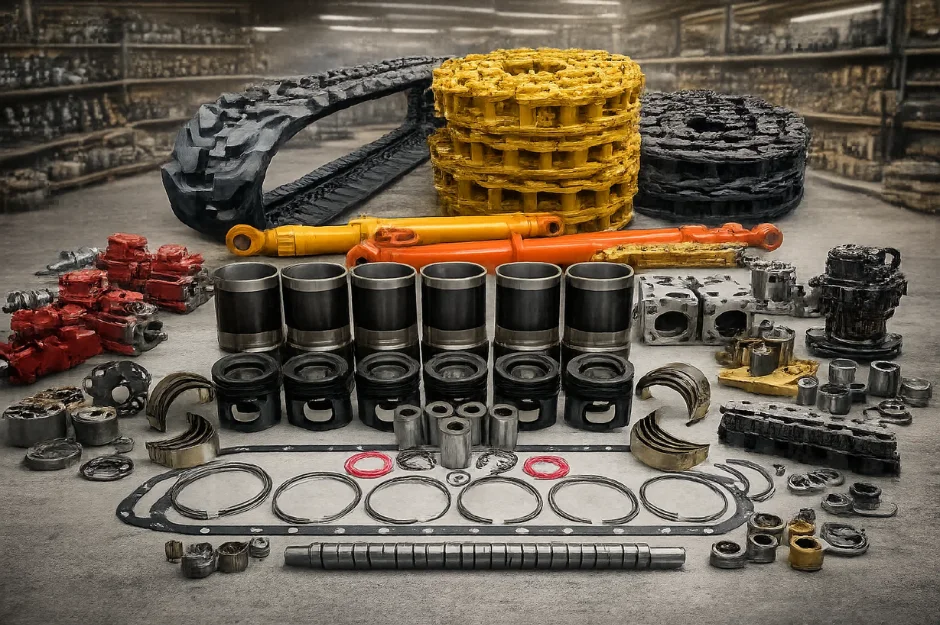
Market Growth and Demand Dynamics
The market for heavy equipment spare parts is constantly on an upward trend globally. It has been reported that the current value of the global heavy equipment spare parts industry is more than USD 168 billion and is steadily heading towards USD 297 billion by 2031, with a compound annual growth rate exceeding 8 % in a decade, as the use of equipment is rapidly increasing due to the increasing number of construction projects taking place worldwide.
There are several market segments that are adding fuel to the growth of the market, including the component requirements of the construction machinery, the mining machinery, the material handling equipment, and the agricultural machinery sectors, all of which experience downtime and thus need immediate availability of components.
Technological Innovation: Transforming the Industry
The future of parts supply is not just about inventory; it’s about intelligence. There are Industry 4.0 technology trends such as predictive maintenance, Internet of Things-enabled sensors, and data analytics, which are rapidly changing the process of managing and replacing parts. With predictive maintenance technology, machines’ performance data is continuously tracked in real time so that predictions on part failure can be made even before the failure takes place. Thus, parts replacement decisions are optimized based on predictive analysis.
Thus, this paradigm shift towards digitalization is forcing the suppliers to adopt platforms where machine data and the availability of parts are combined in one place. This will allow for better forecasting and inventory management decisions to take place. The use of digital catalogs, e-commerce, and mobile ordering solutions is also encouraging customers to easily access part information and place an order, an aspect that will come in handy in markets where response time is key.
Optimal Risk Allocation and Cost Minimization
Global developments in the last decade have also exposed weaknesses within the international supply chain, and many sectors are thus looking to revamp their sourcing models. Components suppliers of construction equipment are also included in these sectors. Sourcing globalization, near-shoring, and the concept of part-hubs within regions have emerged as key methodologies to address risks and ensure business continuity. For instance, businesses in the Middle East and Asia have also started focusing on local logistics facilities to address component supply chain risks.
A balanced approach to sourcing and distribution is essential for markets such as the UAE, which acts as a gateway for the flow of goods between the East and the West. Companies like SINTRA rely on their regional knowledge and the power of global supplier bases to deliver flexible and robust supply performance.
Sustainability and Environmental Regulations
Green factors have increasingly affected the procurement process in the industrial world. This is even more pronounced in countries with tight emission controls. Providers of parts and accessories are feeling the pressure from customers who demand green parts and the use of environmentally friendly practices in the process. This is in the form of remanufactured engines and parts used for extending the lifetime of existing equipment with reduced carbon emissions.
Companies that follow a circular economy, like recycling, remanufacturing, and proper waste disposal, will offer a growing market to customers who value a sustainable environment. This is aside from following sustainable practices set by global governments to safeguard the environment. The global sustainability standards for operations will hold a prominent place in supplier decisions.
Related read:-Why High-Quality Heavy Equipment Spare Parts Matter More Than Cheap Alternatives in Dubai
Strategic Partnerships and Value-Added Services
In order to stay relevant in today’s competitive marketplace, suppliers of spare parts and heavy equipment are focusing on more than just supplying spare parts. Services that are becoming increasingly more important are equipment diagnostic and technical consulting, spare part training, and long-term service contracts.
Major players are also lining up partnerships with Original Equipment Manufacturers, technology, and logistics companies, and through such integrated solutions, they are able to increase client loyalty. They achieve this through a consultative selling approach, where the original focus of the supplier is no longer just enough.
E-commerce, or electronic commerce, involves the buying
The future of spare parts for heavy machinery is moving towards a “digital-first” experience. Online shopping or e-commerce is gaining momentum since consumers are now receptive to the convenience of online shopping, quick updates about the status of deliveries, and transparency of pricing. Digital catalogs enhanced for real-time inventory and compatibility information make buying much simpler and less prone to mistakes.
Technology features, including mobile applications that enable order tracking, maintenance records, and parts manuals, are becoming the norm. These will allow the operator to take charge of the maintenance schedule, thus reducing downtimes, which is critical in industries where production time affects profitability.
Challenges and Future Outlook
Although it has significant growth potential, it is not without its difficulties. These may include disruptions in the supply chain, geopolitical affairs, and raw material price instability. Another challenge is the technology required in heavy machinery, making it essential for manufacturers to invest in skills and technology in this field. Looking ahead, however, the spare parts industry for heavy construction equipment is on the cusp of growth, innovation, and consolidation. The companies that can integrate technological innovation with customer-centric services and sustainability approaches would be at the top of this industry. The new markets in Asia, the Middle East, and Africa would provide great opportunities, while mature markets would continue to innovate.

Conclusion
In summary, it is clear that the future is full of possibilities and change for those supplying spare parts into the heavy equipment industry in the UAE and, indeed, globally. As the world continues into its positive growth pattern thanks to digitalization, sustainability, and supply chain excellence, experts in the field like SINTRAMEA are at the cutting edge, offering more than just spare parts – solutions that keep heavy machinery up and running.